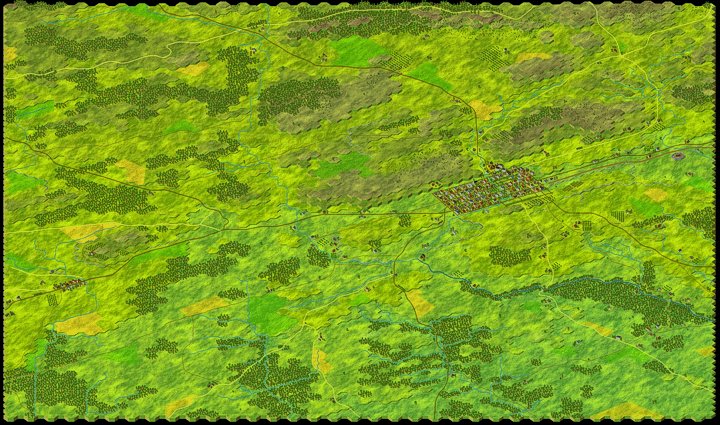
Winchester I

aka Bower's Hill
Frederick County and Winchester, Virginia
May 25, 1862

After skirmishing with Maj. Gen. Nathaniel P. Banks's retreating army at Middletown and Newtown on May 24, Maj. Gen. T.J. Jackson's division continued north on the Valley Pike toward Winchester. There, Banks was attempting to reorganize his army to defend the town. Ewell's division converged on Winchester from the southeast using the Front Royal Pike. On May 25, Jackson gave his troops a few hours rest and then attacked the Federals on Camp and Bower's Hills with 16,000 Confederates coming from three directions.  Ewell attacked Camp Hill, while Jackson's Division struck at Winchester and Bower's Hill.  Jackson sent his Louisiana Brigade to outflank the Federal right. Bank's meager force of 6,500 men were completely overrun.  Panic spread through the Federal ranks, and many fled through Winchester. Banks's army was soundly defeated and withdrew north across the Potomac River.  First Winchester was a major victory in General Jackson's 1862 Valley Campaign. On the tactical level, the battle displays considerable finesse, particularly on the part of Ewell's division on the Front Royal Pike. Brig. Gen. Taylor's attack on Bower's Hill is considered a model brigade maneuver by military historians. The ultimate significance of Jackson's victory at Winchester was its strategic impact. Union plans for a convergence on Richmond were disrupted by Jackson's audacity, and thousands of Union reinforcements were diverted to the Valley and the defense of Washington.

Result(s): Confederate victory

Location: Frederick County and Winchester, Virginia

Campaign: Jackson's Shenandoah Valley Campaign (1862)

Date(s): May 25, 1862

Principal Commanders: Maj. Gen. Nathaniel P. Banks [US]; Maj. Gen. Thomas J. Jackson [CS]

Forces Engaged: Department of the Shenandoah [US 6,500]; Army of the Valley District [CS 16,000]

Estimated Casualties: 2,419 total (US 2,019; CS 400)

Links: The First Battle of Winchester/Bower's Hill - http://www.cr.nps.gov/hps/abpp/shenandoah/svs3-4.html

Designers:  Luciano Bassotti  David Kerns & John Kurtz

Scenario Download:
NOTE:  This is the final version of the game.
  For BGBR 32-bit last version, PBEM only Files
  How to install:

This game is designed for BGBR engine (Talonsoft Battleground Bull Run); this package simply adds a new module, and not affect the scenarios provided with the original game. 

The BGBRUnits file is compatible with the original and other BGBR mods.

SET UP

- Copy Units.bitmap file into BGBR main directory;

- Create a new folder into BGBR main directory and name it Winchester I;

- Copy all others files (except Units.bitmap file) into the Winchester I folder.

See Scenario notes below.

 Map Files

  Note:  Last updated June 24,  2004
  WN1Main0.zip (434 Kb)

  WN1Main1.zip (919 Kb)
  WN1Main2.zip (6,414 Kb)
  WN1Main3.zip (3,885 Kb)

 Other files
  WN1Others.zip (839 Kb)

Scenario Files
 WN1Scen.zip (6 Kb)
  

Unit File (update November 2, 2004)
 
BGBRUnits.zip (1,219 Kb)

     
  How to Start Custom BG-Series Battles Or use Wakeman's ACWCO Launcher
     
  For HPS-CC, PBEM only  
  About the files:
These are modifications for the HPS Campaign Corinth
game, using standard HPS rules.
Not available yet.

Follow the instructions posted there for installation and play.


Scenario Information:

May 25, 1862; 14 Turns [Historical]

May 24, 1862, was a disastrous day for Maj. Gen. Nathaniel Banks. Learning that the Confederates had taken Front Royal and were closing on Winchester, Banks ordered a hasty retreat down the Valley Pike from Strasburg. His columns were attacked at Middletown and again at Newtown (Stephens City) by the converging forces of Maj. Gen. Thomas J. Jackson. The Confederates took many US prisoners and captured so many wagons and stores that they later nicknamed the Union general ``Commissary Banks.'' Jackson pressed the pursuit for most of the night and allowed his exhausted soldiers but a few hours sleep before dawn.

US Deployment at Winchester: Banks now deployed at Winchester to slow the CS pursuit. He had two brigades of infantry under Donelly and Gordon, a mixed brigade of cavalry under Hatch, and 16 guns. Gordon's brigade was placed on the US right on Bower's Hill with its left flank at the Valley Pike, supported by a battery of artillery. The center of the line (Camp Hill) was held by the cavalry supported by two guns. Donelly's brigade was placed in a crescent on the left to cover the Front Royal and Millwood roads with the rest of the artillery. At earliest light the CS skirmish line advanced in force driving the US pickets back to their main line of battle.

CS Advance on Front Royal Pike: During the night, the advance of Maj. Gen. Richard Ewell's division (four brigades) reached Buffalo Lick. At dawn, he deployed his brigades astride the Front Royal Pike and advanced against the Union left flank. His leading regiments (in particular the 21st North Carolina) came under heavy fire from US forces deployed behind stone fences and were repulsed. CS forces regrouped and brought up artillery. After about an hour, they again advanced, this time sending regiments to either side of the high ground to enfilade the Union position. Donelly (US) withdrew his brigade to a position closer to town with his right flank anchored on Camp Hill. Trimble's brigade (CS) then attempted a flanking movement to the right beyond the Millwood Road. This movement threatened the US left and rear. This movement, in conjunction with Confederate maneuvers on the left beyond the Valley Pike, caused the Union line to collapse in this sector.

CS Advance on Valley Pike: In conjunction with Ewell's advance on the Front Royal Pike, Jackson advanced the Stonewall Brigade on the Valley Pike at early dawn in a heavy fog. At Jackson's command, the brigade swept over a hill to the left of the pike, driving off the US skirmishers who held it. Jackson quickly placed a section of artillery on the hill to engage US artillery on Bower's Hill at a range of less than half a mile. Union sharpshooters along Abrams Creek began picking off the cannoneers. In response, Banks moved his artillery farther to the right to enfilade the CS artillery and heavily reinforced his right flank with infantry. Jackson brought up the rest of his artillery and a duel ensued with the Union guns on Bower's Hill. It now appeared that the Union forces were preparing to turn the Confederate left.

To counter this threat, Jackson deployed Taylor's Louisiana brigade, reinforced by two regiments of Taliaferro's, to the left along Abrams Creek. Taylor marched under fire to a position overlapping the Union right and then attacked Bower's Hill. The Confederate assault swept irresistibly forward over the crest in the face of determined resistance. The Union right flank collapsed, even as the left flank was being pressured by Ewell. Union soldiers began streaming back into town.

US Retreat: With the collapse of both flanks, Union forces retreated through the streets of Winchester and north on the Valley Pike. Confederate pursuit was lethargic, as the troops were exhausted from the non-stop marching of the previous week. Nevertheless, many Union prisoners fell into Confederate hands. Ashby's cavalry was disorganized from the actions of 24 May and did not pursue until Banks had already reached the Potomac River.

May 25, 1862  ?? Turns [Hypothetical]

Under development